
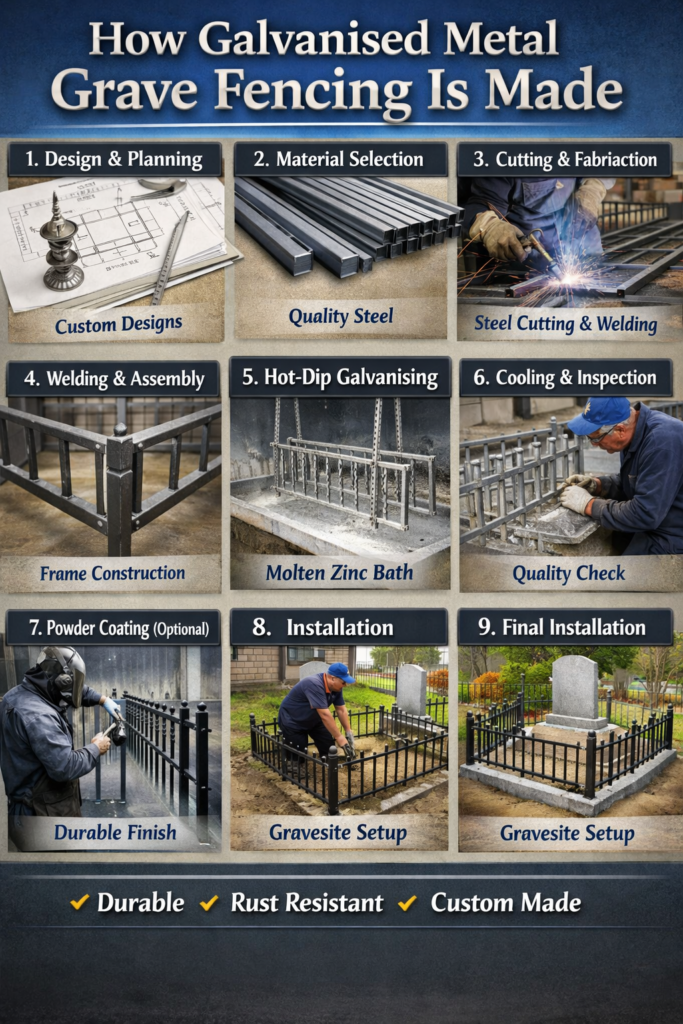
How Galvanised Metal Grave Fencing Is Made
Galvanised metal grave fencing is a durable, elegant, and long-lasting way to protect and enhance a loved one’s resting place. But many people don’t realise the level of craftsmanship and care that goes into creating each piece. In this article, we’ll walk you through the full process—from raw steel to a beautifully finished graveside surround.
Design & Planning
Every graveside fencing project begins with a design phase. This is where measurements, style preferences, and personal touches are decided.
Customers can choose from:
- Traditional or modern styles
- Decorative finials and scrollwork
- Custom sizes to fit specific plots
- Optional features like gates or plaques
For bespoke grave fencing, this stage is crucial. It ensures the final product is both respectful and tailored to the individual.
Material Selection
The fencing is typically made from mild steel, which is strong, workable, and ideal for galvanising.
Steel is chosen because:
- It provides structural strength
- It can be shaped into decorative designs
- It responds well to protective coatings
Only high-quality steel is used to ensure longevity, especially in outdoor cemetery conditions.
Cutting & Fabrication
Once the design is finalised, the steel is cut and shaped.
This process involves:
- Cutting steel bars and rails to size
- Bending metal into curves or decorative shapes
- Welding joints to form a solid frame
Skilled fabricators assemble each section carefully, ensuring the fencing is level, symmetrical, and structurally sound.
Welding & Assembly
All components are welded together to create a single, strong structure.
During this stage:
- Joints are welded securely
- Edges are smoothed and cleaned
- The entire frame is inspected for quality
This ensures the fencing can withstand years of exposure to weather without weakening.
Surface Preparation
Before galvanising, the metal must be thoroughly cleaned.
This includes:
- Removing grease, oil, and dirt
- Acid pickling to eliminate rust and mill scale
- Rinsing to ensure a clean surface
Proper preparation is essential—without it, the galvanising process won’t bond correctly to the steel.
Hot-Dip Galvanising
The steel fencing is dipped into a bath of molten zinc at temperatures around 450°C.
During this process:
- The zinc bonds with the steel
- A protective coating forms inside and out
- The metal becomes resistant to rust and corrosion
This coating can last decades, even in harsh outdoor environments.
Cooling & Inspection
After galvanising, the fencing is cooled and inspected.
Checks include:
- Evenness of the zinc coating
- Structural integrity
- Smooth finish without sharp edges
Any imperfections are corrected before moving to the next stage.
Optional Powder Coating
This process:
- Adds a coloured finish (commonly black)
- Provides an extra protective layer
- Enhances the overall appearance
Powder coating is baked onto the surface, creating a tough, weather-resistant finish.
